How the 2026 revision changes allowable spans for PIR sandwich panel walls
Practical comparison with EN 15254-5:2018 using three worked examples
Marek Gorlický | Head of Testing Laboratory | FIRES, s.r.o.
Based on the enquiries and recurring questions we receive from sandwich panel manufacturers, we have prepared this article to explain the practical impact of the changes in EN 15254-5 on the allowable span of metal-faced sandwich panel walls. The examples focus on horizontally installed panels with a PIR core, for which the revised span-extrapolation rules can materially change the outcome of a test programme.
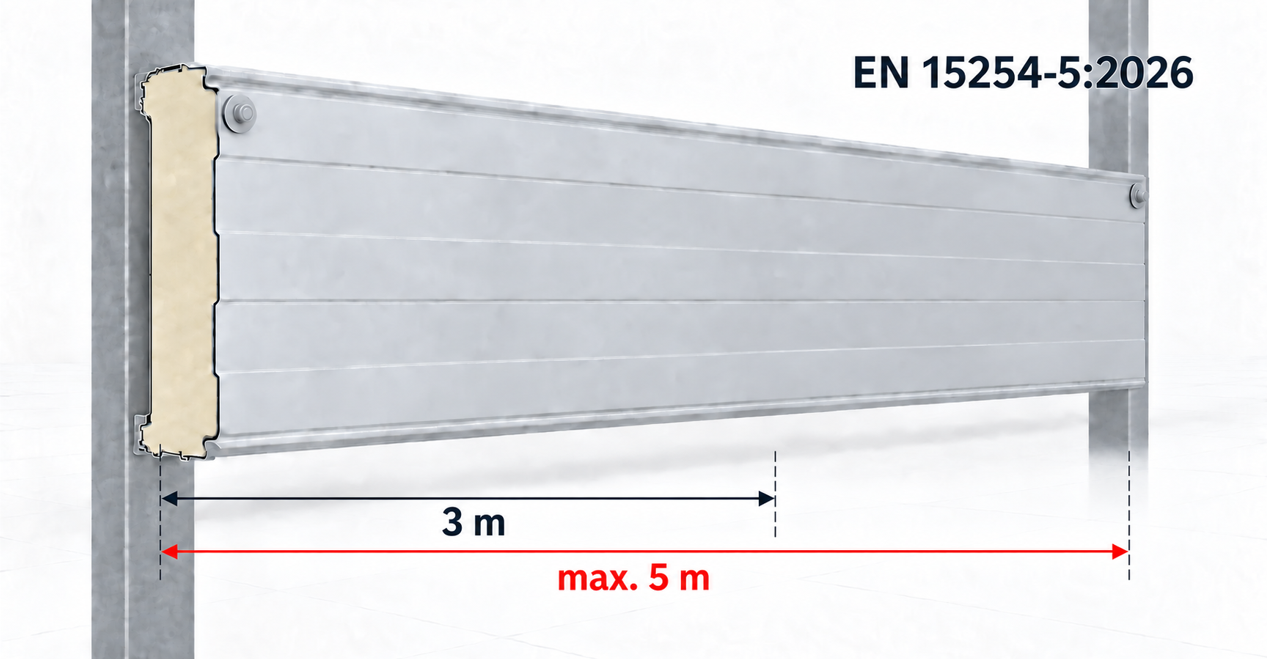
The 2026 revision changes the way a fire resistance result from a standard 3 m span is converted into a larger allowable span. Under the 2018 edition, a test with a 3 m span could support an extension to 6 m or 7.5 m when the result exceeded the requested classification by a defined percentage and by at least 10 minutes. The 2026 revision replaces this rule with fixed time deductions per additional metre. For horizontally installed PIR panels with a classification period of 45 minutes or less, a 3 m test can be extrapolated only up to 5 m.
This matters when a manufacturer is planning a test programme. A strong result at 3 m may no longer provide the span available under the 2018 rules. If a 6 m span is required, the available assessment route should therefore be considered individually, taking into account the applicable EXAP rules as well as the feasibility and uncertainty of any additional testing.
Span rules in the 2018 and 2026 editions
|
Edition |
Starting test | Rule for horizontal PIR panels | Maximum span from the rule |
| 2018 | 3 m | At least 20% overrun and at least 10 min | 6 m |
| 2018 | 3 m | At least 35% overrun and at least 10 min | 7.5 m |
| 2018 | > 4 m | At least 20% overrun and at least 10 min | Tested span + 2 m |
| 2026 | At least 3 m | Classification period ≤ 45 min: deduct 6 min/m | 5 m |
| 2026 | At least 3 m | Classification period > 45 min: deduct 20 min/m from 3 to 6 m | 6 m |
| 2026 | 3 m basis | After the 3-6 m deduction, deduct 35 min/m from 6 to 8 m | 8 m |
| 2026 | Additional test at X m | Deduct 35 min/m |
X + 2 m, not above 10 m |
For horizontally installed PIR panels with a required classification period of 45 minutes or less, the 2026 linear extrapolation rule from a 3 m test applies only up to a maximum span of 5 m. A calculated value at 5 m is not a tested value and cannot be used as the starting point for another two-metre extension. The additional-test rule applies only when an actual test has been performed at span X.
A practical calculation
Example: For the 100 mm horizontally installed PIR-core panel from the table below, tested at a 3 m span with E = 55 minutes, I = 34 minutes and a target classification of EI 30, insulation is the governing criterion.
The 2026 rule deducts 6 minutes for each additional metre:
Maximum span = 3 + (34 – 30) / 6 = 3.67 m
The existing 3 m test can therefore support EI 30 up to approximately 3.67 m under this linear EXAP rule.
It does not support a 4 m, 5 m or 6 m span, and the calculated 3.67 m span cannot be used as the starting point for a second extrapolation.
Worked example for three PIR panel thicknesses
The following simplified example assumes horizontally installed PIR panels from one panel family, each tested at a span of 3 m. Only the effect of span is varied. For an EI result, the governing time is the lower of the E and I results; in all three examples below, insulation is therefore decisive.
|
Panel thickness |
Tested span | E result | I result | Governing EI time | Classification at 3 m |
| 150 mm | 3 m | 65 min | 43 min | 43 min | EI 30 |
| 100 mm | 3 m | 55 min | 34 min | 34 min | EI 30 |
| 60 mm | 3 m | 35 min | 22 min | 22 min |
EI 20 |
Outcome under the 2018 edition
The 2018 calculation compares the test result with the requested classification. Both the percentage reserve and the minimum reserve of 10 minutes must be satisfied.
|
Panel |
Requested class | Reserve above class | 2018 condition | Resulting EXAP span |
| 150 mm | EI 30 | 13 min / 43% | 35% and 10 min satisfied | 7.5 m |
| 100 mm | EI 30 | 4 min / 13% | Not satisfied | No Table 4 extension |
| 100 mm | EI 20 | 14 min / 70% | 35% and 10 min satisfied | 7.5 m |
| 60 mm | EI 20 | 2 min / 10% | Not satisfied | No Table 4 extension |
| 60 mm | EI 15 | 7 min / 47% | Minimum 10 min not satisfied |
No Table 4 extension |
The example shows how strongly the 2018 result depended on the selected classification. The 100 mm panel could not retain EI 30 through Table 4, but the same test result could support EI 20 up to 7.5 m. The separate direct field of application could still be relevant up to 4 m and has to be checked against EN 1364-1 and EN 14509.
Outcome under the 2026 linear rule
For classification periods of 45 minutes or less, the effective result is reduced by 6 minutes for each metre added to the tested 3 m span. The table below shows the EXAP calculation only. It does not replace the separate assessment of the direct field of application from 3 m to 4 m.
|
Panel |
3 m result | At 4 m after -6 min | Class at 4 m | At 5 m after -12 min | Class at 5 m |
| 150 mm | 43 min | 37 min | EI 30 | 31 min | EI 30 |
| 100 mm | 34 min | 28 min | EI 20 | 22 min | EI 20 |
| 60 mm | 22 min | 16 min | EI 15 | 10 min |
No EI period |
Practical comparison
|
Objective |
EN 15254-5:2018 | 2026 revision | Practical consequence |
| 150 mm panel at EI 30 | Up to 7.5 m | Up to 5 m | A 6 m span is not established by this 3 m result |
| 100 mm panel at EI 20 | Up to 7.5 m | Up to 5 m | A 6 m span is not established by this 3 m result |
| 100 mm panel at EI 30 | No Table 4 extension; direct field may reach 4 m |
3.67 m by the linear calculation; direct field checked separately | Check the direct field route for 4 m |
| 60 mm panel at EI 20 | No Table 4 extension; direct field may reach 4 m |
3.33 m by the linear calculation; direct field checked separately |
No EXAP route beyond 4 m from this result |
What manufacturers should decide before testing
- Define the required classification and maximum span before the test programme is fixed.
- Use the same panel orientation that is required in the end-use application.
- For horizontal PIR panels requiring EI 45 or less, the linear rule from a 3 m test does not extend beyond 5 m.
- Do not chain a calculated 5 m result into the additional-test rule. Span X must be tested.
- Check the direct field of application to 4 m separately; it may be more favourable than the linear EXAP calculation.
- Confirm that the panels belong to the same family and that joints, facings, core, adhesive and fixing details meet the EXAP conditions.
Where three panel thicknesses are tested, the standard can also support linear interpolation for intermediate thicknesses, provided the family conditions are met. A result for a thinner panel is valid for a thicker panel, but a result for a thicker panel cannot be used to justify a thinner one. These thickness rules do not remove the separate span restrictions.
Under the 2026 approach, the tested span has a greater influence on the resulting field of extended application. A 3 m test can support common low fire resistance classifications up to 5 m, but cannot itself establish a 6 m application. Any further assessment or testing should be considered individually, including its feasibility and uncertainty.
Technical basis: EN 15254-5:2018, Clause 5.3.1, Table 4 and Annex B; FprEN 15254-5:2026, Clause 5.3.1, Table 4 and Annex B.How the 2026 revision changes allowable spans for PIR sandwich panel walls